
This article was first published in the May 2026 issue of Fire Apparatus & Emergency Equipment Magazine.
For years, the emergency lighting conversation centered on a single metric: output. More LEDs. More lumens. More brightness.
But when an engine company is blocking an intersection and cross traffic is moving at 45 miles per hour, output alone does not protect firefighters.
Recognition does.
Roadways have become visually saturated environments. LED billboards, daytime running lights, traffic signals, construction signage, and digital displays compete constantly for drivers’ attention. In that landscape, simply increasing brightness does not guarantee clearer communication. In some cases, it can create more visual clutter.
The future of emergency lighting is not about producing more light. It is about producing the right light - controlled, uniform, and recognizable from every angle.
Listening to Firefighters
That shift did not begin in a lab. It began with conversations out in the field.
Jon Sestrom, Product Manager at Whelen, has spent years working directly with departments, gathering feedback from firefighters, and translating real-world challenges into engineering requirements.
One issue comes up repeatedly: intersections.
“At an intersection, you don’t get a second chance,” Sestrom says. “If a driver doesn’t recognize the warning immediately, that’s where accidents happen.”
The issue is not simply brightness. Firefighters consistently describe situations where warning systems appear powerful head-on but lose effectiveness from the side. Cross-traffic may see light but not interpret it quickly enough.
Recognition time becomes the differentiator.
This insight shifts the conversation from sheer brightness to purposeful light distribution, setting the stage for how engineers approach optical design in modern systems.
From Output to Optic Control
Modern LEDs deliver extraordinary raw output. Generating light is no longer the primary challenge.
Controlling it is.
Amy Beckman, who led the development of Whelen’s latest rotating platform, approached the project with a different objective than simply increasing performance metrics.
“LEDs produce enormous output,” Beckman explains. “The real engineering challenge is deciding where that light should go, and where it shouldn’t.”
That mindset marks a significant shift in warning system design.
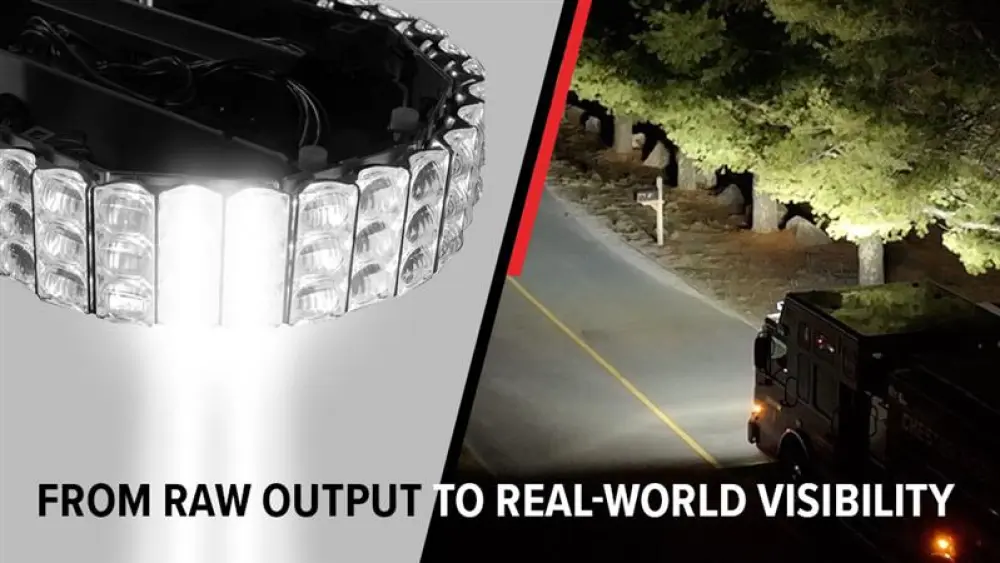
Rather than dispersing light broadly and relying on sheer brightness, the focus turns to beam shaping - directing energy intentionally, minimizing wasted spill light, and maintaining consistent intensity across the entire 360-degree footprint of the vehicle.
Directional systems serve important roles in certain applications. But they introduce a critical limitation: off-angle performance drop-off. A system that appears intense from the front may lose effectiveness as vehicles approach from the side or at oblique angles.
For fire apparatus operating in complex, multi-lane intersections, that inconsistency creates risk.
Uniformity becomes essential.
Precision optics allow engineers to transform raw LED output into focused, controlled beams that maintain consistent intensity from every approach angle. That means:
- Even, 360-degree coverage
- No dark spots or weak zones
- Maintained performance regardless of which color is active
- Reduced glare and improved visual clarity
Multi-color capability has become standard in modern warning systems. Historically, switching between colors often meant varying intensity or uneven distribution. Inconsistent output can affect how drivers interpret signals in high-speed environments.
Advanced optical engineering now allows systems to maintain intensity across color changes while preserving even spread across the lightbar. The visual message remains consistent - no matter the configuration.
This is not simply a cosmetic improvement. It directly affects how quickly a driver processes what they are seeing.
And in roadway operations, milliseconds matter.
Watching Technology Evolve
Few people have seen the progression of warning technology as closely as Geoff Marsh.
Now CEO of Whelen, Marsh began his career as an engineer and worked on the original Rota-Beam™ systems decades ago. He has witnessed the transition from mechanical rotating systems to early LED integration and now to precision optical refinement.
Each generation addressed one challenge and exposed the next.
Early development emphasized durability and rotational reliability. The next era focused on LED efficiency and longevity. Today, Marsh sees the frontier clearly defined.
“Directional systems lose performance off-angle,” Marsh says. “A true 360-degree system has to maintain equal intensity from every approach.”
That statement reflects a broader philosophy: warning systems must communicate effectively from every direction, not just the most convenient one.
The evolution is no longer about simply replacing components. It is about refining how light behaves in real-world environments.
Shaping the Light: Introducing FocusBeam™ Technology
This philosophy of precision light distribution is realized in the all-new Freedom® V lightbar, featuring FocusBeam™ Technology, a recent innovation from Whelen.
Externally, a system like the Freedom V may appear familiar to departments operating earlier generations. The housing and mounting architecture remain consistent by design.
The transformation is internal.
FocusBeam Technology represents a significant advancement in how LED output is harnessed and shaped. Rather than relying on broad dispersion and raw brightness, Whelen’s precision-designed optics convert that output into purposeful, controlled beams.
The result is uniform illumination across the entire 360-degree footprint of the vehicle, maintained intensity across active colors, and the elimination of weak zones or dark gaps.
It is not a reinvention of the platform. It is an evolution of the optical system within it.
For departments, that means improved performance without changing the architecture they know and trust. For engineers, it reflects the next stage in warning philosophy, shifting from chasing output to designing light with intention.
The Responsibility Ahead
For firefighters and agency leaders, the implications are straightforward.
Improved optic control translates into:
- Faster driver recognition
- Clearer visual cues
- More predictable behavior at intersections
- Consistent warning performance from multiple approach angles
These gains do not necessarily appear as larger numbers on a spec sheet. They appear in reaction time. In reduced confusion. In safer scenes.
Roadways remain one of the most dangerous operating environments firefighters face. Even incremental improvements in recognition can have a meaningful impact.
Marsh frames the mission simply:
“As long as there are still responders being injured or killed on the roads, there’s more work to do.”
The future of emergency warning will not be defined by a race for higher lumen counts. It will be defined by precision, uniformity, and intentional optical engineering that prioritizes communication over raw output.
Because emergency lighting is not about producing more light.
It is about ensuring responders are seen - from every angle, in every condition, at every critical moment.
And that work continues.