
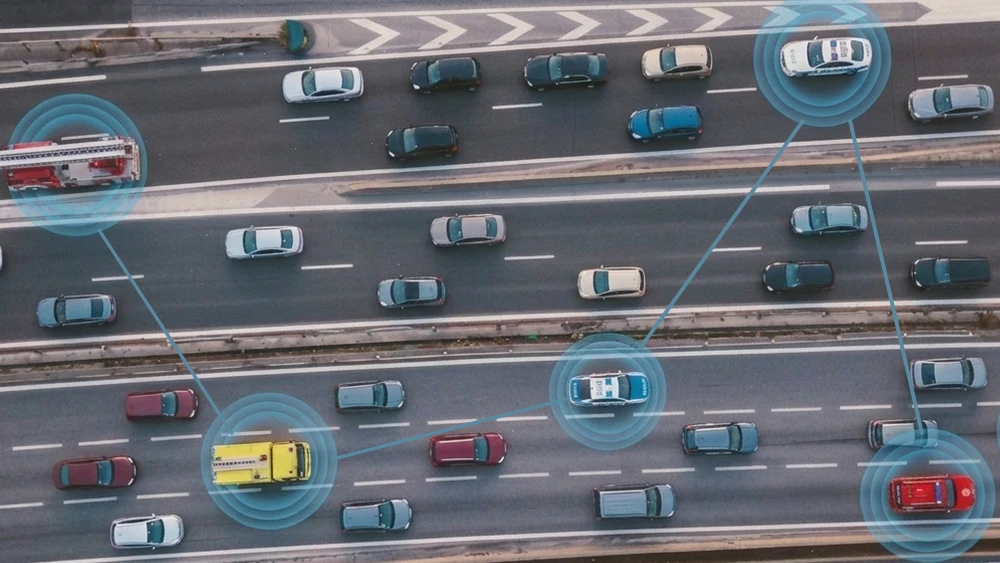
For decades, emergency warning systems have relied on one fundamental requirement: drivers have to first see or hear the signals in order to react. Even with today’s highly advanced lighting and siren technologies, this reality hasn’t changed. Further, roadway environments move faster and offer more competition for driver attention than ever before, increasing the difficulty of an emergency vehicle being seen or heard.
Modern vehicles are engineered for a quieter experience and insulated against exterior noises. Drivers navigate crowded roadways while managing navigation systems, phone calls, and other distractions. At the same time, emergency warning signals vary widely across jurisdictions, often leaving drivers unsure of what they’re seeing - or how they’re supposed to respond.
When warning signal communication breaks down, even briefly, the risk increases. With emergency vehicles often traveling at high speeds, a delay of just a few seconds can significantly reduce the time and space drivers have to react safely.
That’s where connected vehicle technology changes the equation.
By adding data as a third form of communication - alongside lights (visual signals) and sirens (audible signals) - emergency vehicles can now proactively alert across the roadway environment. Instead of relying solely on drivers to detect a signal, connected warning systems can alert them in advance, providing more time to react and better context for what’s happening around them.
How Connected Vehicle Technology Works
Connected vehicle technology essentially links emergency vehicles, roadway infrastructure, and other drivers through real-time data.
Using GPS and cellular connectivity, an emergency vehicle warning system shares information - such as location, speed, direction, and operational status-with a cloud-based network. That network can then distribute relevant alerts to navigation systems, mapping apps, roadway infrastructure, and even other responders.
This creates a more complete communication system.
Instead of a single signal that depends on visibility or audibility, drivers receive layered information with context to help them understand not just that an emergency vehicle is present, but what it’s doing and how they should respond. Importantly, this information can be pushed out up to 30 seconds in advance, pre-alerting drivers to be scanning for audible and visual warning signals.
Data also reduces variability. Traditionally, many warning features-like flash patterns or siren tones-depend on the operator to manually activate them at the right time. Human error, stress, or divided attention might prevent an operator from activating a given feature, leading to inconsistent messaging. With connected systems, those signals and features can be automated, standardized, and aligned with the situation, helping drivers interpret them more accurately over time.
Key Features That Make Communication Smarter
Connected vehicle technology becomes most effective when applied through specific, coordinated features that improve clarity, consistency, and timing.
Geofence Controlled Technology (GCT) allows warning systems to automatically adjust based on location. In high-risk areas like intersections, school zones, or blind curves, geofencing ensures that warning signals are activated or modified at the right time and distance without requiring manual input from the operator. Over time, consistent use of these location-based signals can help drivers better understand what’s expected of them in specific scenarios, reducing confusion and hesitation.
GCT can also provide governance, ensuring policy and procedures are applied consistently during a response. For example, an agency may direct operators to change siren tones and flash patterns when “clearing” intersections. GCT easily automates this process, keeping the operator’s eyes on the road and hands on the wheel.
Traffic Preemption directly addresses one of the most dangerous points on the roadway: intersections. Today’s connected emergency vehicle can integrate with traffic signal pre-emption systems commonly in use.
By giving emergency vehicles priority control over traffic signals– empowering operators to request a green light in their direction and a red light for all others-preemption removes ambiguity. Instead of calling for right-of-way and competing against drivers with a green light, responders are supported by one of the most universally understood signals on the road: a red light.
Drivers don’t need to interpret flashing patterns or siren tones in these moments. They simply respond to the traffic signal, which greatly reduces the likelihood of collisions and creates a safer path through the intersection.
Digital Alerts extend communication directly into the vehicle.
Through connected networks, alerts are delivered in real time to drivers via mobile apps and integrated navigation systems. These alerts provide early awareness - sometimes well before a driver can see or hear an emergency vehicle.
That additional time matters.
When drivers are alerted earlier, they’re less likely to react abruptly or incorrectly. They’re also less likely to assume the emergency vehicle is directed at them personally, which can reduce panic and allow them to focus on safely moving out of the way.
Responder-to-Responder (R2R) Alerts focus on protecting those behind the wheel of emergency vehicles when they are most vulnerable.
Rather than coordinating actions, these alerts notify responders when another emergency vehicle is nearby or on a potential collision course. In high-stress situations, this kind of alert can break through tunnel vision, prompting the driver to slow down and actively scan their surroundings.
Preventing responder-to-responder collisions not only protects those on the road, but it also preserves critical resources. When a responder is involved in a crash, it impacts the ability to respond to the original call and any others that may follow.
Safety in Action: A Layered Approach
No single system solves every challenge on the roadway. Real safety gains come from layering these technologies together.
Traditional lights and sirens still play a critical and practical role, but when combined with connected data, digital alerts, geofencing, and traffic preemption, their effectiveness increases significantly to create a system built for safety.
These technologies work together to:
- Provide earlier awareness
- Deliver clearer, more consistent messaging
- Reduce reliance on split-second human decision-making
- Increase the time available for drivers and responders to react
On the road, time translates directly to distance - and distance creates safety.
By reducing confusion and standardizing how warnings are delivered, connected systems help drivers move more confidently through the decision-making process: observing, understanding, deciding, and acting. At the same time, they reduce the cognitive and physical demands placed on responders, allowing them to stay focused on driving.
Safer Roads Through Smarter Communication
The next level of roadway safety is driven by data.
Connected warning systems reduce the potential for human error, extend the window for reaction, and create a more consistent and understandable communication system for everyone on the road.
Just as importantly, they help re-educate drivers.
For years, inconsistent warning strategies have led to uncertainty and hesitation. By standardizing how emergency vehicles communicate - across agencies, regions, and technologies - we can begin to rebuild that understanding. Over time, drivers learn what to expect and how to respond, leading to safer outcomes for both the public and the responders who serve them.
Smarter vehicles aren’t just about technology - they’re about clearer communication.
And clearer communication offers powerful advantages to prevent tragedy and save lives.
You can access all these safety features and more with Whelen Cloud Platform®. Click HERE to learn more or connect with a sales rep for a demo.
- Whelen connected vehicle technology improves emergency response safety by combining traditional warning lights and sirens with real-time digital alerts.
Through the Whelen Cloud Platform® (WCP®), emergency vehicles can share location and status information to alert motorists and responders earlier, improve situational awareness, and provide more time to react safely. - The Whelen Cloud Platform uses Geofence Controlled Technology, Traffic Preemption, and Digital Alerts to improve emergency vehicle safety.
These features can automate warning light and siren behavior based on location, help emergency vehicles gain priority at traffic signals, and notify motorists of approaching emergency vehicles before they can see or hear them. - Whelen Responder-to-Responder (R2R) alerts help protect emergency vehicle operators from potential collisions.
By notifying responders when another emergency vehicle is nearby or on a potential collision course, WCP helps improve driver awareness and supports safer emergency responses.
