
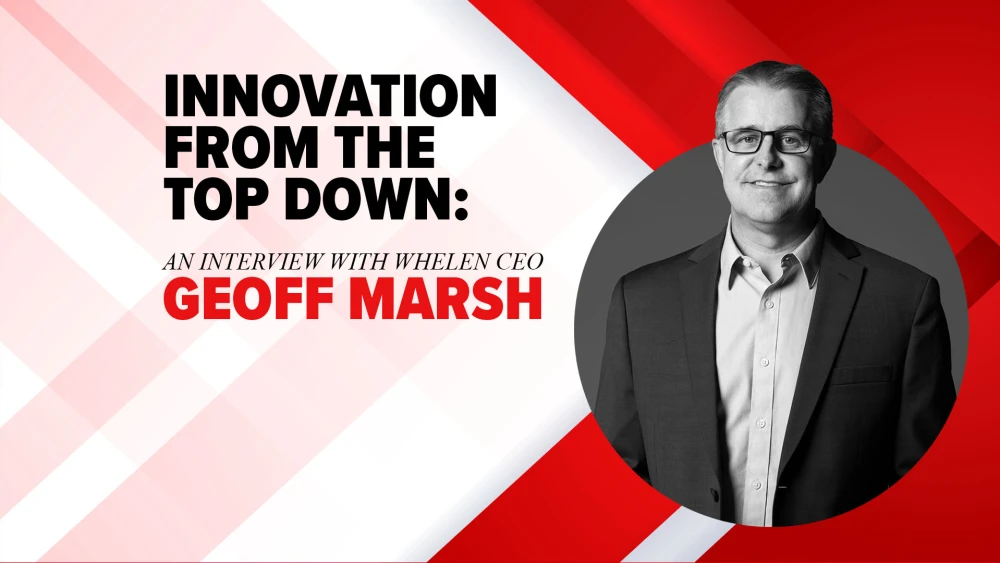
When Geoff Marsh joined Whelen in 1994, he wasn’t thinking about corporate innovation strategy. He was a mechanical engineer solving problems.
His first years at Whelen were spent in product development, testing, and validation, including work to improve the reliability of mechanical rotating beacons in extreme environments. As warning technology evolved from mechanical rotators to strobes to high-powered LEDs, his role evolved with it - from engineer to engineering leader and, ultimately, CEO.
More than three decades later, that experience still shapes the way Geoff thinks about innovation. But one of the most important lessons he’s learned is that innovation isn’t really about the technology at all.
It’s about identifying a problem worth solving, understanding the people experiencing it, and being willing to listen when a better idea comes from somewhere you didn’t expect.
We sat down with Geoff to talk about what his engineering career taught him about innovation, why the next great idea can come from anywhere, and what leaders have to do to make sure success never turns into complacency.
You started at Whelen as an engineer in 1994. How has that experience shaped the way you think about innovation today?
Early in my career, I tended to think more about the technical solution than I did about the first responder and the actual problem statement.
What I’ve learned through the years of development is that you really have to start with the end use in mind. What does the first responder need to be safer on the road? What is going to warn people more effectively that they need to do something differently, so they don’t ultimately hit a first responder or enter an emergency scene?
You start with that in mind, and then you work backward toward the best technology to solve it.
You were involved in the development of the original LED Rota-Beam™. What did that experience teach you?
When I first started here, we still had mechanical rotators. My first project was actually trying to improve the reliability of one.
In harsh environments - especially extreme cold - the rotators could freeze up. The light would still be on, but the reflector wouldn’t turn. I spent a lot of my early development years working on making those products more reliable across a huge environmental range.
At the same time, the industry was changing. Strobe technology was becoming more accepted, and then LED came along. LEDs had lower power draw, much longer life and fewer modes of failure. As they became bright enough to compete with the best strobe products, that became a major development path for us.
But there was still a desire, particularly in urban environments, for a rotating beam. At an intersection, for example, you can have that concentrated light bouncing off buildings before you ever see the emergency vehicle itself. So, we were trying to solve for that need using the technology that was available to us.
That’s something that continues today. New materials and technologies change what’s possible. With newer silicone materials, for example, we gained the ability to make very thick, complex optics with incredible precision - something that would have been much more difficult with the thermoplastics we used previously. That’s helped enable what we’re able to do with products like Freedom® V today.
The technology keeps changing. The important thing is understanding what you’re trying to accomplish with it.

As an engineer yourself, do you think innovation primarily comes from engineering?
No - and that may surprise people coming from an engineer.
Innovation doesn’t necessarily come from engineering. It can, of course. Sometimes we see a technology and realize we can apply it in a way that hasn’t been done before.
But innovation can come from anywhere.
Quite often, some of the best innovations come from the end user. It comes from someone simply saying, “There’s got to be a better way.”
I’ve always told engineering teams to listen to everybody. The person coming in and emptying the trash that night might make an observation and say, “Hey, did you ever think about this?” And suddenly, there’s the spark of an idea.
The engineer may ultimately have to figure out how to make it work. But the idea itself can come from anywhere.
That’s also why I’ve always placed a high value on people within our engineering teams who are involved in volunteer fire or EMS. They’re seeing things firsthand. They’re going on calls at night, observing what happens in real situations, and bringing those experiences back to us. We can learn from that.
If innovation can come from anywhere, what role does leadership play in creating that culture?
One of the most important things is making sure we’re asking the right question.
Fundamentally, the question I always come back to is: What is the problem we’re trying to solve?
It’s very easy in development to start chasing a tangential squirrel because you’ve found an interesting way to solve a complex technical problem. But if nobody cares about the problem you’re solving, you haven’t advanced the state of the art.
Sometimes we even need to challenge what we believe the problem statement is. Is this really the bigger issue? Is what we’re looking at actually a subset of something larger?
You have to keep the fundamental problem in front of you while you’re thinking through the solution.
Whelen has been successful for nearly 75 years. What does the company need to do to remain an industry leader?
As we grow and become more successful across our markets, we have to continue making time to really listen to the industry and to end users and understand where technology is taking the world around us.
We always need to be on the front edge of that and make sure we’re solving the most relevant problems as new ones emerge.
One of my favorite books is Take the Stairs, and there’s a line in it that I’ve always subscribed to: “Success is not owned. It’s merely rented, and the rent is due every day.”
The worst thing that can happen with success is that you begin to coast.
That’s probably one of my biggest fears - that success allows us to stop pushing as hard, stop looking for problems to fix, or allow technology or the needs of the industry to move past us.
Our mission makes that pretty simple. As long as lives are still being lost in the work first responders do, we have a job to come here and do.
We’ll never be done with that.
When you look at the future of Whelen and the industry, what excites you most?
I’m excited for the day when vehicles are truly connected.
Fire, EMS, and law enforcement often have different dispatch protocols. They arrive on scenes with different responsibilities, and there’s a coordination effort that can be challenging because an accident isn’t planned. You can rehearse certain things, but there’s always a live, dynamic aspect to the real world.
I think our products have an opportunity to better integrate what’s happening at those scenes and automate more of it. Automation can work very quickly, and it doesn’t become stressed by the situation. It functions according to the logic you give it.
I’m excited for the day when those scenes come together, and first responders can be 100 percent focused on the task at hand - not on setting up the scene in a way that makes them safer.
I think we’re headed in that direction.
After more than three decades at Whelen, what still makes you excited to come to work every day?
People. Very simple.
The people make this business, and we have the best people in the industry here, without a doubt.
I’m challenged by them. I’m challenged by the skills they bring and the problems they’re trying to solve. As long as there are problems to solve and people to help and engage with, I’m excited to come to work.
Lessons from Three Decades of Innovation
Geoff’s career has put him at nearly every level of the innovation process - from the engineer working through the limitations of a mechanical rotator to the CEO thinking about how an entire organization prepares for what’s next.
But his philosophy hasn’t become more complicated as his role has grown. In many ways, it has become simpler.
Listen to the people doing the work. Understand the people you’re trying to protect. Stay curious about what’s changing. Don’t allow success to become complacency. And keep asking questions.
Because leadership may help create the conditions for innovation, but it doesn’t get to decide where the next great idea will come from.
At Whelen, it can come from anywhere.